About Me
Blah blah blah, etc.
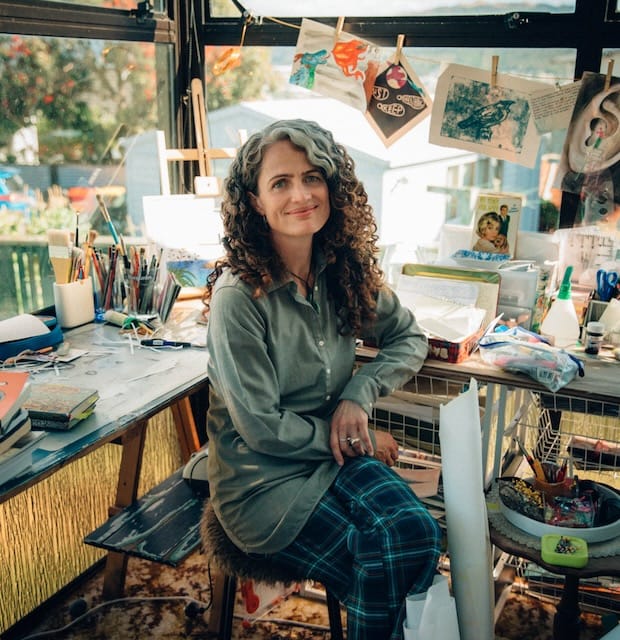
Kia ora, nau mai ki taku kokonga o te ipurangi - welcome to my lil corner of the indi-web. He uri tēnei nō Ngāti Hine, he Pākehā hoki - I'm from Ngāti Hine on my Dad's side and English/Irish on my mother's. My writing springs from my lived experience as an indigenous wahine from Aotearoa New Zealand resisting late stage capitalism through storytelling. When I'm not working, writing, hustling or at wānanga, you'll find me knitting or sewing or gelli-printing or screenprinting or repairing typewriters or collaging or zinemaking or journaling or binding books at Rebel Press. Yeah, it's a bit out of control. I live in Te Awa Kairangi/Hutt Valley with my Mum and partner, and even though my three children have left home, I will never relinquish my claim to the title of 'solo-Māmā'.
Iti te Kupu
Iti te kupu refers to a whakatauki/proverb he iti te kupu, he nui te kōrero. It's a way of expressing in te reo Māori the capacity of short words to convey deep and nuanced ideas, often through metaphor. I also like the inference that one blog can cover many topics, which this one definitely does. You'll find political advocacy about climate change and social justice mixed in with musings about mental health, grief, art, parenting, love and relationships. I don't publish too frequently because I know people's inboxes are already overflowing. I aim for quality and contextually relevant. Behind the paywall, I share more personal stories and tips on writing and craft. To become a paid subscriber, it's $5 a month or $50 a year. Every sub is greatly, greatly appreciated - whether paid or free. I hope you receive something valuable and useful in return. Yes, I do give away comps! If cost is a barrier, or if you ever need to pause your paid membership, please just send me an email.
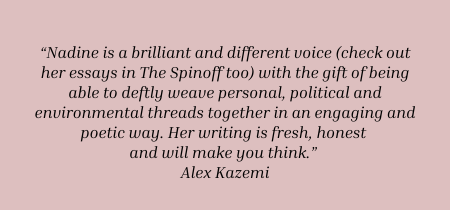
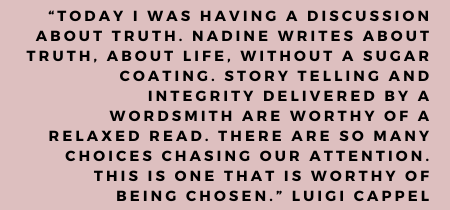
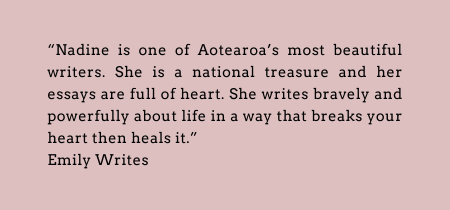
Here are some lovely things other people have said about this blog...
Bio
Below is a selection of bios of differing lengths and tones containing the usual shorthand information about me. Read: stuff I've done or achieved. If you're looking for my bio, please feel free to adapt, edit or smoosh from below as needed.
Nadine Hura, (Ngāti Hine, Ngāpuhi, Pākehā) is a poet, essayist, podcaster, zine-maker and Māmā based in Te Awa Kairangi, Wellington. Her blog, 'iti te kupu' revolves around indigenous reclamation as creative practice.
Nadine Hura (Ngāti Hine, Ngāpuhi, Pākehā) is a writer whose work connects literature, social policy and environmental justice. She has written extensively for The Spinoff, E-Tangata and other platforms. She is a Māmā, a poet, essayist and a member of the independent publishing collective, Tarakehe Press. Slowing the Sun, published by BWB in 2025, is her first full length collection of essays.
Nadine Hura (Ngāti Hine, Ngāpuhi, Pākehā) is a writer whose work connects literature, social policy and environmental justice. Her work with Māori communities on climate research for the Deep South National Science Challenge led to many of the essays in Slowing the Sun. She has written extensively for The Spinoff, E-Tangata and other platforms. Hura, a Māmā, poet and essayist, lives in Wellington while pursuing her writing and advocacy for the protection of Papatūānuku and the revitalisation of mātauranga Māori.
I work in the intersection between the arts, science, policy and storytelling, providing strategic leadership in roles that extend from grassroots to governance. I'm passionate about all forms of indigenous storytelling, in particular supporting other indigenous writers to enter the world of publishing through zines, chapbooks and other independent pathways.
Awards and tings: Hone Tuwhare Resident 2025, Pikihuia Winner (non-fiction) 2021 & 2023, Voyager Awards Finalist for Best Feature Essay (Listening to the Silence), 2021. Michael King Writer's Residency (Emerging Māori Writer) 2019,
Some publishing highlights
In addition to Slowing the Sun, you can find my writing in some beautiful physical books like Woven, Rapture, No Other Place to Stand, Te Awa o Kupu, Ngā Kupu Wero, We Are Here, as well as the Huia anthologies 13, 14, 15. Below are some of the stories that you can find online - starting with my favourite piece writing I've ever published:
"It makes me wonder at the cosmic accident that determines who our siblings will be and where they will find us. One minute he was beside me, the next minute he was gone, swallowed up by the crowd. I searched and searched and searched but it was like he had never been. I wandered through the raised hands and the heaving shoulders and the pounding feet, looking for him. How can you lose someone that was right in front of you? All my dreams are of looking for my brother." One Life, A son for my Brother - The Spinoff
"As poetic as it sounds, the connection between land and placenta is not metaphoric. It is literal. You have to really believe you are entitled to your entitlements to think that the economy can do a better job at providing for people than the placenta." A climate change glossary for the overwhelmed - The Spinoff
"He has his own daughter, and she has her own father, but in the rugged terrain of relationships love grows wild. We can make space for all kinds of unexpected people. We can form bonds with women who are not our mothers but provide for us as if they were, and men who are not our fathers but know us better. Often what these relationships teach us is how to let go of what we can’t get back, or never had, and just accept what is." Hands Fluent in Silence - E-Tangata
"My brother was different, like Māui. He couldn’t leave things alone. He needed to know. My brother used to break things in order to see how they worked. He knew he’d get a hiding but he’d do it anyway." One Life - The Spinoff
"The immensity and cascading nature of the environmental challenges facing Māori communities – coupled with a severe lack of economic resources to respond, while occupying a position of ongoing structural inequity – is overwhelming. More than once I felt like kneeling down. There’s a kind of awe that hits you when you understand the scale of the loss and the commitment required to heal and recover." 5 climate adaptation lessons from Māori communities (guaranteed not to depress you) - The Spinoff
"He was never ashamed of his blanket. Not the first time he unpacked it inside the clamoring year nine dorm. Not ever. A mother can sacrifice a lot for simple acknowledgments like that. Some of the most important things we say to the people we love are wordless." Koru - Guernica Magazine
"I keep asking myself: what is the point of the refrain ‘amplify Indigenous voices’ if the people who need to hear aren’t listening?" Riding Shotgun - PEN International
"The summer I decided to leave him I was reading a book by Junot Diaz called This Is How You Lose Her. There was some light-hearted banter about my lack of subtlety, but by Easter the good humour had dissolved into tears and spit. By winter we were throwing dollar bills into the flames of relationship counselling, and later, lawyers." Tis the Season to be solo - Essay on Sunday
There was some light-hearted banter about my lack of subtlety, but by Easter the good humour had dissolved into tears and spit. By winter we were throwing dollar bills into the flames of relationship counselling, and later, lawyers.
"I couldn’t write the poem because I was reviewing my Dipsea Wrapped, an ethical alternative to porn (and poetry for that matter). According to my stats I spent 334 minutes listening to rough and dirty audiobooks this year. Which, when you consider there were over five hundred and twenty five thousand minutes available to pleasure myself, is frankly a disgrace." The Poem - Red Room (with Alison Whittaker)
Interviews, podcasts and video
"What does it take to keep the home fires burning in Aotearoa, and why is the term “land back” synonymous with climate action? Find out with Nadine Hura and Ruia Aperahama, in a four part series brought to you by Te Kōmata o Te Tonga." Ko Papa Ko Rangi
"In this liminal space, time really does feel negotiable. You believe you can walk right up to death in your dreams and speak to it." On the dual crises of climate change and mental health - TED Talk
Nadine Hura shares her journey travelling through the seasons of grief following the loss of her brother to suicide. Short documentary, Aro - Māori Television
Two minute explainer introducing Slowing the Sun - BWB - Youtube
"Wellington essayist Nadine Hura's new collection Slowing the Sun is a karanga to those who have left us and those still with us, with a message to hold fast to ancestral knowledge for future generations." RNZ Saturday Morning with Mihi Forbes
"When it comes to the creative process, people often say to me: “I don’t have time.” No one’s gonna give us time — the time that we think we need and want — to do the writing, so we just have to steal it. Often, we have to steal it from somewhere else in our lives. I’m often stealing it from sleep, but if this thing is something that you have to do, whichever art form it is, it’s almost like it’s not a choice." Oriented to the light - Interview with Dale Husband, E-Tangata
Nadine joins The Detail's Alexia Russell to discuss why she felt compelled to write about New Zealand's clutch of eligible non-voters – 17 percent of the total population, but rising to 27 percent among Māori. Make voting sexy again - RNZ Long Reads
Where to purchase
I occasionally sell my zines here on the website. Otherwise, you can find Slowing the Sun ($39.95) from BWB (or any independent bookseller). It's also available on Amazon Kindle and Google Play. Sadly, Narrating the Seasons of Grief is currently out of Stock. I'd love to do another print run if there's enough interest, so please let me know.
Reviews of Slowing the Sun
'It’s the New Zealand book from last year that has stayed with me the longest. It’s a climate book, but not the kind built from distant graphs and policy debates. Instead it brings the crisis close to home, weaving science, journalism, whakapapa and personal story into something that feels urgent, grounded and deeply human … It’s the rare kind of book that changes how you see the world around you: the landscape, the stories we tell about it, and our responsibility to care for it. Quietly powerful and intellectually generous, Slowing the Sun feels like an essential book for Aotearoa right now.' Caleb - Newsroom
'A stand-out essay collection from one of the finest nonfiction writers in the country. Hura’s inquiries draw science, grief, pūrākau, poetry and bone-deep intelligence to pull climate change close. The work Hura does in this book helps us see the climate crisis as inextricable from daily life: a story we are living and can take ownership of.' – Claire Mabey, The Spinoff
'It’s easy to be overwhelmed by the climate crisis and disengage from it. But Hura reminds readers that “anything you do to benefit the land benefits you, often immediately. The environment is the healer, not the other way around”. I have never read a book like this before —deeply personal, yet relevant to everyone. Even the most seasoned climate scientist will learn a lot.' – Tara McAllister, Nature
'Wildly informative and generous, Slowing the Sun begins as an inquiry into the world of climate change activism and swiftly unfolds into an interrogation of the racist hierarchy of knowledge. These essays welcome us into conversations being had in the margins, about our relationship with the natural world and the abundance of mahi that is dedicated to protecting that relationship.' – Māia Te Whētu, takahē magazine
'Nadine Hura’s book Slowing the Sun: Essays is both lyrical and insightful. At a journalistic and research level this collection of essays offers focused, intelligent and thorough investigations into the causes, effects and science of climate change. It explores the ways in which colonisation and extractive capitalist practices have in both the past and the present adversely impacted on tangata whenua and fed into the climate crisis we now face.' – Gina Cole, Landfall
'Slowing the Sun is a book I didn’t want to or couldn’t rush. It is so beautifully, delicately, radically perfect, a book that needs to be savoured, underlined, highlighted, with a lot of notes and Post-it tags. Nadine captures it beautifully when she writes how, “Māori communities aren’t captured by the deficit language of climate change….People on the ground talk about Indigenous reclamation, constitutional transformation, anti-colonialism, radical dreaming, joy, creativity, pride, and a future seven generations bright.”' – Shilo Kino, Newsroom
'I loved this book. I loved it so much. Slowing the Sun is a collection of essays that attempt to interpret or reckon with climate change as a story that the reader can actually enter.' – Elizabeth Heritage, RNZ Nine to Noon
'Wellington essayist Nadine Hura's new collection Slowing the Sun is a karanga to those who have left us and those still with us, with a message to hold fast to ancestral knowledge for future generations... Through science, pūrākau and poetry, Nadine attempts to understand climate change in relation to whenua and people.' – Radio New Zealand
'My book deals with grief and loss, because wherever there is colonialism, there is grief and loss. But there is also strength, endurance, intelligence, wit, and just really hardworking, hard-case people doing their best in terrible and unjust circumstances. As a writer, that’s your privilege. You get to choose what to give light to: the systems or the people. I chose the people.' – Nadine Hura, interview with Dale Husband, E-Tangata
'One element that makes Slowing the Sun so striking is [its] ability to weave in the personal, whānau-grounded kōrero with unwavering activism and politics.' – The Māori Literature Trust | Te Waka Taki Kōrero
Find more reviews on Goodreads.
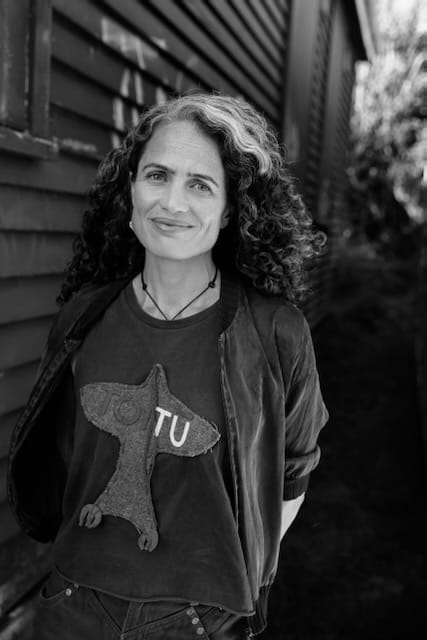
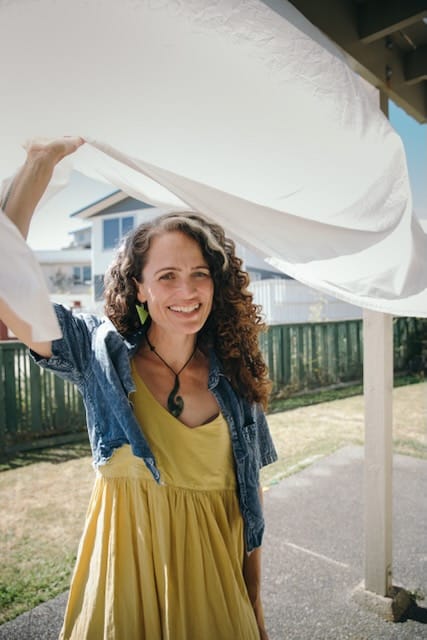
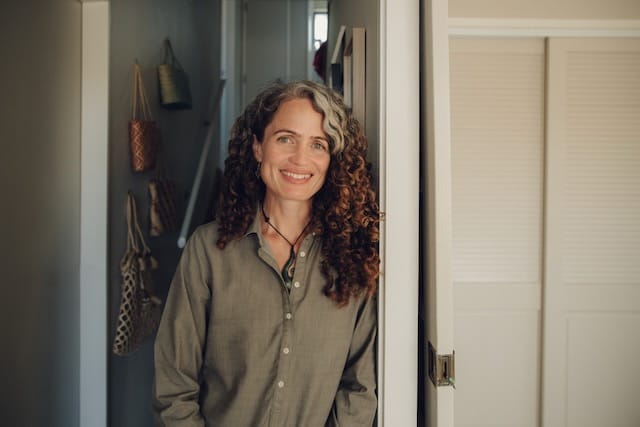
Profile Pics

d