The problem with self-sufficiency in a crisis.
Far better than stockpiling fuel, we ought to be stockpiling social cohesion.

There was a single busker in the Wellington Railway station when I walked through the tunnel on the 23rd of March 2020. I was the last to leave my floor at 3pm and the streets were almost deserted. I tried to make eye contact with the busker but he was crooning into the far distance and never saw me. The station in Porirua was similarly desolate. I sat alone in my car with its flat battery in the rain and waited. By the time my brother arrived with jumper leads I’d written a poem imagining Papatūānuku’s relief that humans were finally laying down their weapons of mass extraction and going home to be with their families. I wasn’t mad. I wasn’t even scared. Like a lot of people, I found the initial weeks of the pandemic novel and welcome. People were going out of their way to support each other. Socially distanced gatherings popped up in cul-de-sacs in the late afternoon sun. Employers were uncharacteristically generous. Sharing became the new economy. It was as if the world suddenly and miraculously righted itself.
The trouble with hindsight is that everything is illuminated. I can see now that I was no different to that busker. The signs were there from the start. While I was panic-buying a ukulele, Darren was stockpiling boxes of Kingfisher and toilet paper and tins of beans and bags of rice and pasta. While I was having zoom calls in my pajamas, the afternoon unfurling in front of me like an open-road, he was sitting in the dark by himself watching YouTube videos. It’s harsh to remember, but necessary to admit, that I actually laughed when he came into the house wearing a full face gas respirator of the kind you’d expect to wear to outer space. He was months ahead of government mandates on mask-use and wasn’t even the slightest self-conscious walking around the supermarket breathing like Darth Vader. We argued. He said I wasn’t taking things seriously enough. I told him he needed to chill out. I couldn’t understand how someone who’d spent their entire life lifting and crawling and carrying and scraping could be so opposed to reclining in a chair with their feet up on the government’s dime.
The flaw in my thinking was assuming he believed the government gave a shit about him. My error was believing he trusted the levers of democracy or consented to being governed. Lockdown reminded me of the time our stepfather tried to ground him, aged 15. He left the same afternoon and never came back. You can’t take away something from someone that was never yours to deny.
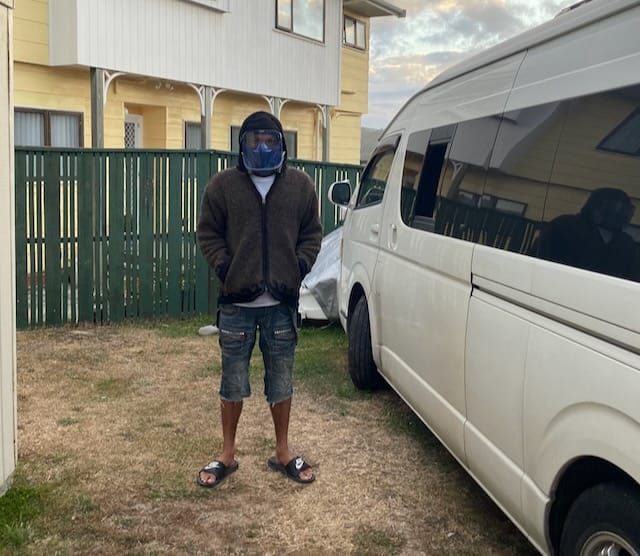
The fractures began to appear before the end of the first week. Police knocked on my door following a 105 report that my brother’s van, registered to my address, had been spotted parked in an unauthorised place. I lied and said he was due back shortly. And he did return - that time. I remember walking around the neighbourhood glancing up at the windows, wondering who’d dobbed him in and whether it was the same person who filmed their family dancing on the kitchen counter celebrating their newfound freedom in lockdown.
By August 2020, the fractures were so deep we were avoiding whole subjects of conversation. He’d given up sending me videos about 5g and Bill Gates and the Plandemic and our exchanges had become increasingly confrontational. On the afternoon of the 12th of August, the second lockdown was declared. I texted Darren to ask what time I should expect him. I was secretly glad. Another lockdown would force him to come back to my place where I could keep an eye on him.
But he just sent me a photo of a fire by the river under a sky full of stars and told me that my system could get fucked. I never saw him again.
*
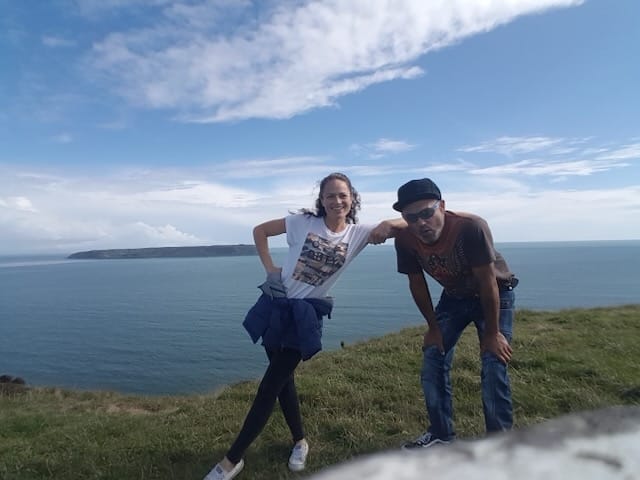
Take a text book on mis and disinformation and under risk profiles you’ll find my brother and me: one of us is more or less inclined to trust the state and one of us never has and never would. Six years later, I notice how much more I fit the risk profile now: I don’t trust this government. I don’t believe this coalition cares about me or my whānau. I don’t think the government values anything other than the economy, not even life itself. Luxon is happy for my kids to be pushed overseas if they cannot find work at home. Willis refuses universal subsidies for public transport in the same breath as admitting her family isn’t affected by prices at the pump.
I can point to miles and miles of evidence that proves, in my mind, that this government hates poor people, hates disabled people, hates women, hates Māori, hates students, hates teachers, hates firefighters, hates public servants, hates sick people, hates doctors, nurses, care-workers and workers in general. The government’s response to pain, hunger and poverty is punishment for the sufferers and entitlements for the rich. Worse, the ‘system’ Darren was so skeptical of has been eroded even more drastically in the past six years. Democracy across the world is in a state of mockery at the hands of corrupt tyrannical white men and their chumps. I go to sleep watching cities burn in Iran and Lebanon and wake up in the middle of the night feeling guilty for spiralling into worst case scenarios as they would affect me personally: that my daughter gets stuck in Dunedin and can’t come home. That medical supplies run out. That the already faltering healthcare system collapses completely. That wealthy people empty the super-market shelves to fill their bunkers and leave nothing for families who cannot even afford to eat today, let alone hoard for tomorrow. That self-sufficiency gives way to selfishness. That there will be violence.
Considering the current situation, I think it’s reasonable to be scared. The analyses I’ve read, and that you’re likely reading too, are alarming. Even without modelling data and expert opinions, we’re all members of households; we can all do basic math. As tough as things are, we also all know people doing it worse than us. We worry for them more. When Nicola Willis stands in front of an oil tanker at Marsden point in a turquoise jumpsuit and a lopsided hard-hat, I do not have any confidence that she knows even one inch of what she’s talking about. I actually feel like she’s treating us like idiots. I understand enough about the connection between oil and fertilisers to imagine the cascading impact on crops that fill our supermarkets let alone the price of imported food. Tamanuitērā is well on his way to his winter bride and frosts will soon be coating windowsills with fresh layers of black mould, freezing pensioners in their beds and filling babies’ lungs with hacking coughs. Meanwhile, the government declares a leisurely Level 1 status and says nothing about the jerry cans running out the door and people stockpiling fuel.
A lack of trusted information and sources gives rise to panic. The Labour Government’s crisis response stands in stark comparison to this one’s. The Labour government went ‘hard and early’ at the start of the pandemic. This coalition seems to have adopted a ‘late if at all’ approach. At press conferences, ‘responsibility’ is reinforced over relief, with Willis announcing miserly ‘targeted and temporary’ support for a tiny proportion of the population. During Covid, the Prime Minister’s daily 1pm briefings were book-ended with the famous phrase “be kind” - which people took literally. Every time Luxon and Willis are interviewed they sound like a jilted ex whose only motivation is to demonstrate how they would have handled the Covid crisis (and I shudder to imagine).
*
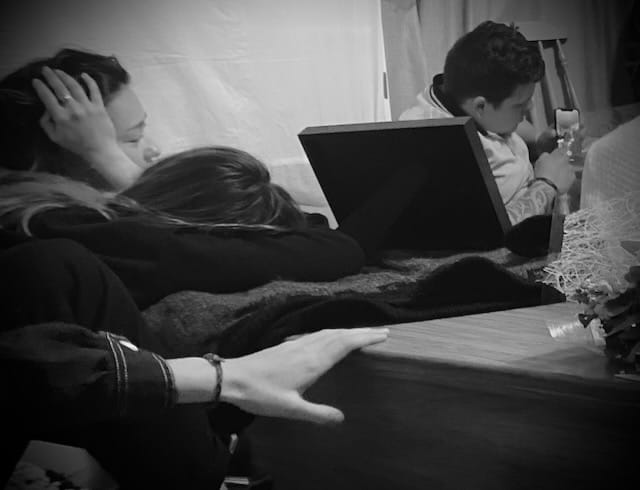
When Darren was spiralling he was alone. The consequences of fear and panic combined with social isolation aren’t always predictable, but the conditions are ripe for mis and disinformation (the former being false information believed to be true, the latter being lies intentionally spread with the intent to cause harm). The lessons from Covid show that conspiracies took a relatively long time to arrive here, but when they did they bolted - we consumed something like 30% more Russian disinformation than the USA. Māori communities, my brother included, were an easy and deliberate target. Disinformation is known to be most successful when it is able to exploit existing fears and suspicions. Well-funded foreign groups know how to sow distrust into soil already tilled by colonialism and intergenerational trauma. Those same groups directly benefit when our communities turn against each other, or on ourselves. We still haven’t fully recovered from the vaccine mandates in Aotearoa and evidence of the fractures are visible everywhere on social media. Add to that almost three years of a relentlessly cruel government, and people are under unimaginable pressure. Couples, siblings, families: all of us in the same boat, but coping differently. Some will want to trust the government, some will stop watching thef news altogether, others already know they’re on their own and are getting ready.
But the trouble with self-sufficiency as a goal is that none of us is ever truly alone. We are deeply interdependent. In practice, as we’ve seen repeatedly in Te Tai Tokerau and Te Tairāwhiti and other post-disaster sites, self-sufficiency in a crisis really looks like collective sufficiency. It’s code for the ability to meet our own needs without relying on the state to come and save us. This is where communities truly shine. People share what they have. People meet each other’s needs. People literally save each other's lives. It’s beautiful. It’s tragic.
Far better than stockpiling fuel, then, what we ought to be stockpiling is social cohesion. Things are going to get harder. We do need to prepare. But we don’t need to be able to grow everything. As Whaea Donna Kerridge said at a Mana Wahine soil and seed sovereignty wānanga last week, ‘you might be good at growing just one thing’. It might not even be kai. You might not have a patch of grass to poke a stick at let alone plant a māra. But you might be the one who makes a mean sour dough or fry bread. You might have other things to share; time, skills, tools, mending, rongoā, a chest freezer, old preserving jars, kaimoana, seeds from that pumpkin you ate last night. You might have nothing at all. That’s ok. We got you.
Or you might be like my neighbour, John Harawira. John is 74, retired, diabetic, with a 40 year old rēwana bug and a passion for cooking. He can’t even eat half the kai he makes but that’s not the point. The point is to stock his fridge with ready-to-heat bags of kai so that when his moko come over, they can take whatever they want. Spring rolls, wantons, curries, bread. He loves it. It's normal. This way of life is all he’s ever known. He was one of 11 growing up in Bethlehem, Tauranga Moana. They never went hungry. His whānau had an orchard with plums and peaches and nectarines and watermelons and apples, as well as kamokamo, spuds and kūmara. On the other side of the channel were the pipi beds and flounder and titikō, with tuatua on the ocean side of the inlet. They had animals, too. But they never killed an animal for themselves, John says. Only ever for tangi - and always to give away.
Because whatever we give away comes back to us in abundance. If everyone lived by these values, we’d all have enough. Nā tō rourou, nā taku rourou, ka ora ai te iwi. Sharing is saving - literally and spiritually. Think about what you love. Think about what you have and can do. See who might need help. Go round with a shovel. Or just to share a cup of tea. Tell your friends and colleagues and neighbours what you’re passionate about. Find out what they can do. Social cohesion thrives on interdependence. It’s code for whakapapa - and it is the only viable long term response available to us.
*
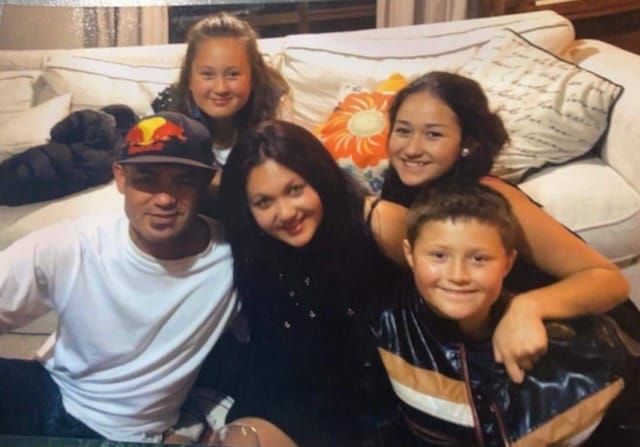
In many ways, my brother was ahead of the curve. I didn’t connect his death to the You Tube links he’d been sending me until months after we lost him. I like to hope that I’d spot a spiralling person now, and I hope you would too. There are things we can do to inoculate ourselves. We need to keep talking to each other. Social inclusion and belonging is key. We need to tell each other our worst fears and be able to express our deep distrust without feeling like we’ll be ridiculed or laughed at or dismissed. We especially need to catch each other before we spiral - an increasing risk in a world that feels so enormously fucked that who can really blame a person for feeling as if there is no point to anything?
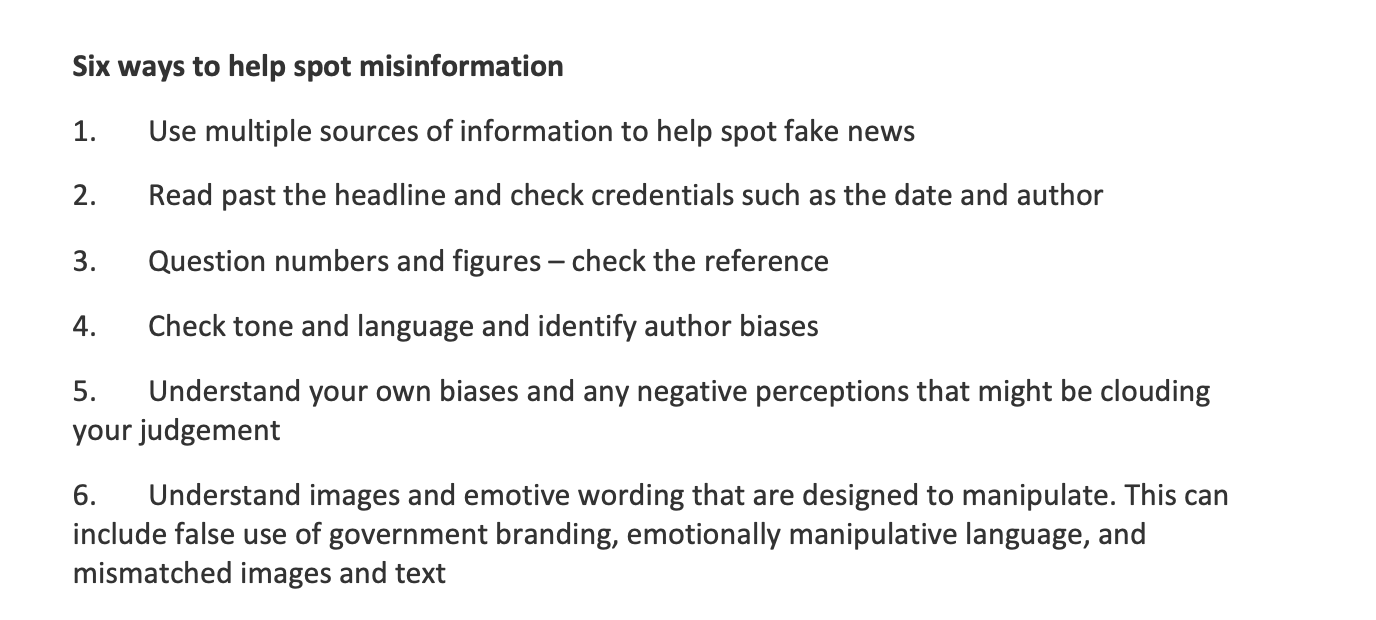
Disinformation isn’t going away. With such low levels of public confidence in the state and democracy, combined with the pace of technology, we should expect to see oil crisis conspiracies popping up any day if not already. How can we spot mis and disinformation? For a start, we all need to critically analyse the source of the information we’re consuming. Check our biases, yours as well as mine. Are you new to this blog? Check out who I am and if I can be trusted.
Here’s another six top tips:
*
I live with remorse. But the beauty of hindsight is that everything is illuminated. The only reason I happened to get talking to Pāpā John is because we caught the bus together. When I sat down next to him in the bus shelter I was deeply engrossed in researching this story on my phone. He interrupted me, and said ‘where’re you from, girl?’ I could have carried on reading but I put down my phone and talked to him instead. He told me about his life in Bethlehem and his years working in construction after he moved to the city in the 60s. He told me about riding their horse across the channel to collect pipi. Then he pointed out my bus stop to catch the train and we waved goodbye.
The next day, I found John's place easily, and took over some free range eggs and a bag of lemons and a copy of this story. The same afternoon, he filled up his walker with kai like it was a station wagon and pushed it over to mine. There was a pot of hand-made wonton noodle soup with spinach, fried prawn wantons, sweet and sour pork wontons, and a gigantic bag of frozen wontons for the freezer. He sat with me and Mum and had a cuppa, while Darren grinned down at us from the wall.
Today, I’m going to the farmers' market. I have a feeling this is going to be a long game.
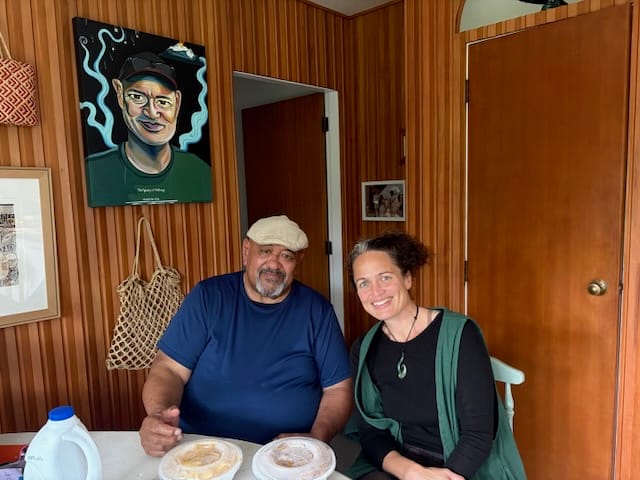
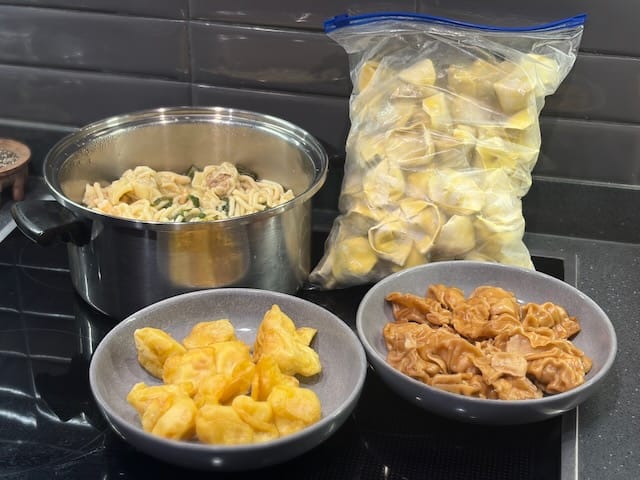
Left: Pāpā John and me having a cuppa with painting of Darren by the uber talented Tina Walker-Ferguson behind us. Right: enough kai to feed us all the way to next week.
If everyone gives from what they have in abundance, we’ll all have enough.
*Mihi nui ki a Pāpā John (for letting me take our pic!). Waihoki, ki ōku tuakana: Melanie Mark-Shadbolt for the links and kōrero, and Jessica Hutchings and Jo Smith for gathering a beautiful group of mana wāhine to wānanga soil and seed sovereignty last week, which caught me just at the right moment and inspired this blog.
Please check out the Mana Wahine Declaration, share and support the rematriation of our planet!
References and links:
I highly highly recommend this related blog by Jo Wrigley, who I can absolutely vouch for:
“When you remove the question “what should the government do?” and replace it with “what do you already have?” our conversation shifts. A retired nurse who knows about food as medicine. A kuia whose knowledge of rongoā has never formally been asked for. A block of ten neighbouring businesses that have never once spoken to each other about their shared interests. A community garden that’s been quietly running for eleven years and has never been mapped as infrastructure. A cargo bike in someone’s garage. A WhatsApp group that becomes, within seventy-two hours of a crisis, the most functional supply chain in a two-kilometre radius. We have always been living with more than we thought, are more capable than we believe and less alone than the isolation of modern consumer life has made us feel. Covid showed us this. Climate events confirmed it. And now, as the fuel wars arrive, we are being invited again to reconnect, test our neighbourhood relationships, look for opportunities to connect, walk down the street and greet people as we pass by. The simplest and most direct route to community cohesion.
More links...
- RNZ Covid Timeline
- If there was a disaster next week, where would you go for food?
- The Disinformation Project
- Public Research and Insights into Disinformation | Department of the Prime Minister and Cabinet (DPMC)
- Working paper on mis and disinformation in Aotearoa
- Russian disinformation targets NZ with te reo Māori news site - NZ Herald
- Defence analyst warned about threat of Russian disinformation in NZ 'for years' | Stuff
- Facebook data reveal the devastating real-world harms caused by the spread of misinformation :: University of Waikato


